OpenClaw
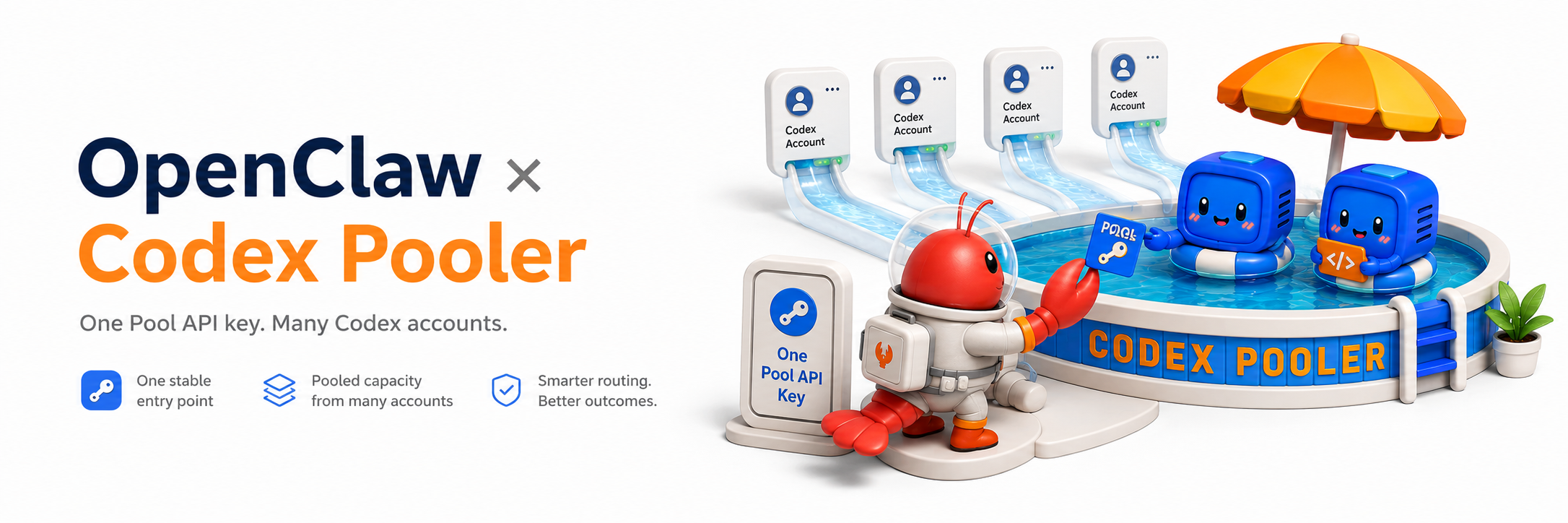
OpenClaw should use Codex Pooler through the narrow OpenAI-compatible /v1 surface. Keep openai/* model names when you want OpenClaw and its tools to treat the model as the canonical OpenAI provider path. The optional MCP block is only for operator metadata tools.
For a deployed instance, use these URLs:
OpenAI-compatible base URL:https://codex-pooler.example.com/v1
Operator MCP URL:https://codex-pooler.example.com/mcp
For local setup, replace the host with http://localhost:4000.
Provider shape
Section titled “Provider shape”OpenClaw’s OpenAI provider should point baseUrl at Codex Pooler’s /v1 surface, use a Pool API key for model requests, and pin the agent runtime to openclaw. The older pi runtime id is a deprecated alias and should not be used in new Codex Pooler examples.
{ agents: { defaults: { model: { primary: "openai/gpt-5.6-terra", list: [ { id: "background", model: "openai/gpt-5.6-luna", }, ], }, compaction: { reserveTokens: 128000 }, }, }, models: { mode: "merge", providers: { openai: { baseUrl: "https://codex-pooler.example.com/v1", apiKey: "${CODEX_POOLER_API_KEY}", api: "openai-responses", agentRuntime: { id: "openclaw" }, timeoutSeconds: 300, models: [ { id: "gpt-5.6-luna", name: "GPT-5.6 Luna via Codex Pooler", reasoning: true, input: ["text", "image"], contextWindow: 828400, contextTokens: 828400, maxTokens: 128000, }, { id: "gpt-5.6-terra", name: "GPT-5.6 Terra via Codex Pooler", reasoning: true, input: ["text", "image"], contextWindow: 828400, contextTokens: 828400, maxTokens: 128000, }, { id: "gpt-5.6-sol", name: "GPT-5.6 Sol via Codex Pooler", reasoning: true, input: ["text", "image"], contextWindow: 828400, contextTokens: 828400, maxTokens: 128000, }, ], }, }, },}Define only model ids your assigned Pool can serve. If you run Codex Pooler locally, set baseUrl to http://localhost:4000/v1.
OpenClaw separates the configured contextWindow from the effective runtime contextTokens budget. The 828400 values above are long-profile examples for models whose selected Pool catalog source reports an 872000-token raw ceiling. Provider accounts can temporarily report different ceilings for the same model; a selected 272000-token profile exposes 258400 instead. Use each model’s /v1/models.context_length for both fields and do not configure the raw ceiling. For the long-profile example, the 128000-token compaction reserve keeps output accounting explicit and starts local compaction at 700400 tokens. Use gpt-5.6-luna for background routing, keep gpt-5.6-terra as the primary model, and switch a session to gpt-5.6-sol only for heavy reasoning.
Operator MCP server
Section titled “Operator MCP server”Add Codex Pooler as a remote Streamable HTTP MCP server only when OpenClaw should inspect metadata that the operator can already see in the admin UI. Omit this block for normal model/runtime use.
{ mcp: { servers: { codex_pooler: { url: "https://codex-pooler.example.com/mcp", transport: "streamable-http", headers: { Authorization: "Bearer <operator-mcp-token>", }, }, }, },}Use http://localhost:4000/mcp only for local setup.
MCP uses an operator-owned MCP token, not a Pool API key. Don’t reuse the Pool API key from the model provider block for /mcp.
Custom provider option
Section titled “Custom provider option”If you want to keep Codex Pooler separate from OpenClaw’s built-in OpenAI provider behavior, you can use a custom provider id such as codex-pooler/gpt-5.6-terra instead.
That follows OpenClaw’s generic custom-provider shape, but tools that look specifically for openai/gpt-* model refs won’t see it as canonical OpenAI. Prefer the openai provider shape above unless you need that separation.
Compatibility notes
Section titled “Compatibility notes”OpenClaw model requests use Codex Pooler’s narrow OpenAI-compatible /v1 support for selected SDK routes. Codex Pooler doesn’t provide full OpenAI API parity.
GET /v1/responses is narrow Responses websocket compatibility, not /v1/realtime support. /v1/realtime and OpenAI Realtime SDK websocket or session routes are unsupported.
The operator MCP endpoint is rooted at /mcp. It uses an operator-owned MCP token, not a Pool API key.